1. Introduction
We've all seen the picture of a mass distorting spacetime, as if it is bending some sort of 'net' beneath it.
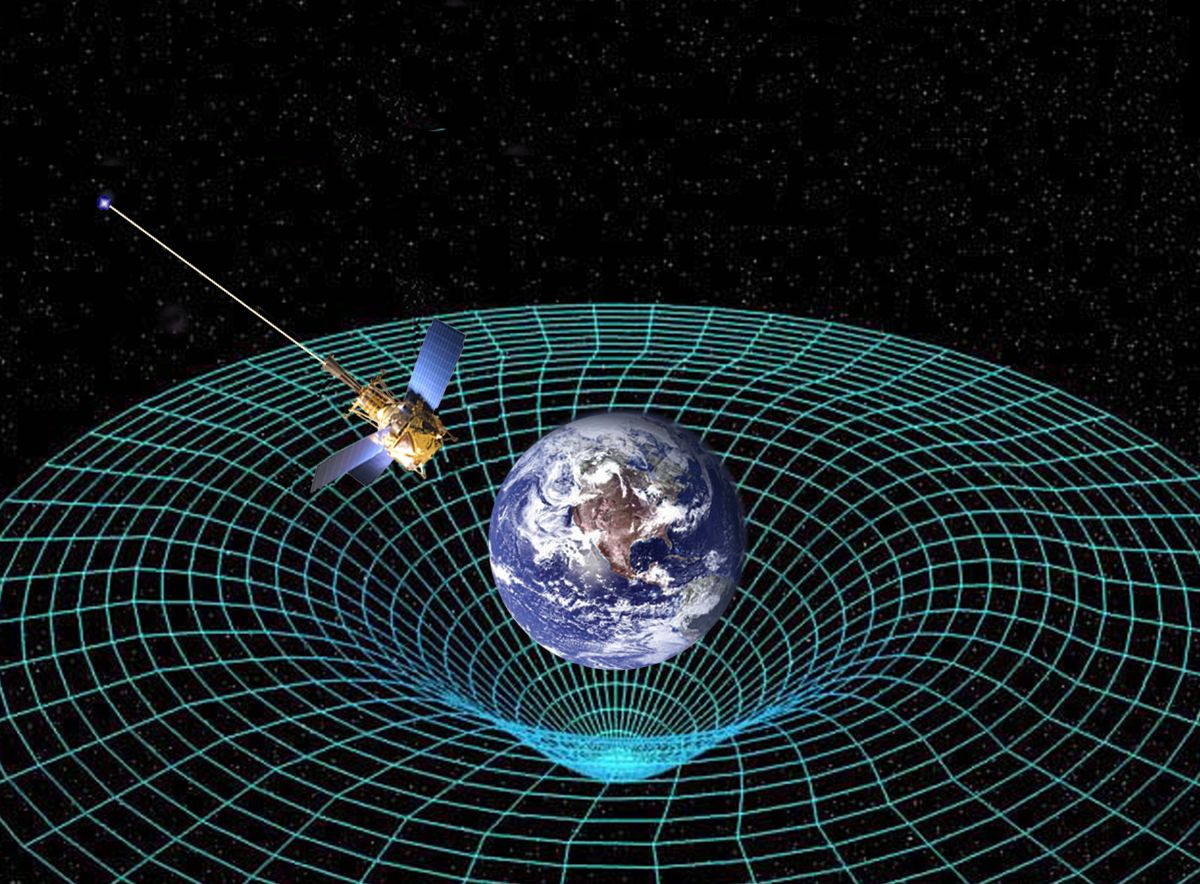
And with General Relativity's discovery of gravitational waves, it initially does not seem that ridiculous to ask what it would mean for spacetime to behave as a fluid. Actually, when you really do think about it, it is a really bizarre question. Because essentially you are treating spacetime as a substance, and we need to define the properties of this substance. For example, say I am at some point \(x^\mu\) in spacetime. If that is a point of a substance, how do we keep track of which points are the same? What is outside this substance? Is it living in its own spacetime?
Anyways, it is still very interesting to think about. I was very curious about this question for some time, and now that I finally have the math to explore it, that is exactly what I will do! Here, I'll try to briefly develop the mathematical framework for a fluid-like spacetime, what the properties of this substance might mean, and what compression, flow, and folding actually mean when we include time itself in this 'spacetime substance'.
2. Keeping track of the substance
Before we can ask whether spacetime can flow, we should probably decide what is flowing. In an ordinary fluid, this is pretty straightforward. We can pick a small piece of water, give it a label, and follow it as it moves. Its position changes, but we still treat it as the same piece of water. Of course, actually keeping track of it experimentally is another problem, but mathematically we know what we mean, and we will leave that problem to the engineers!
Spacetime is trickier. A point \(x^\mu\) describes an event, including when it happens. If we follow something through time, we then see different events. So a single spacetime point cannot really be the same as a water chunk which stays the same as time passes. We need to distinguish the events from whatever connects them into the history of the same piece of substance. The first step was to give each hypothetical piece of this medium a label \(a=(a^1,a^2,a^3)\). Then its history is described by:
\[ x^\mu=X^\mu(\tau,a). \]
Here, \(a\) tells us which piece we are following, while \(\tau\) tells us where we are along its history. For a fixed label, changing \(\tau\) traces out a curve through spacetime. I chose \(\tau\) to be the proper time along that curve. This does not require another time outside our universe. The parameter \(\tau\) measures time along a path within the spacetime we already have. Also, the notation does not require an outside, ambient space for our substance to move into: \(X^\mu\) gives coordinates of events in that same spacetime. The direction of each history gives us a possible flow field:
\[ u^\mu=\frac{\partial X^\mu}{\partial\tau}. \]
This is a four-velocity, so it includes the temporal direction as well as the spatial ones. Using \((-,+,+,+)\), the East Coast metric (as we are putting on our gravity hats today), it satisfies
\[ g_{\mu\nu}u^\mu u^\nu=-c^2. \]
Fantastic, the histories are timelike. I don't know whether this is a sign of success, but I always feel quite uncomfortable getting spacelike results. But I have already made an assumption here; we have decided that the pieces of the medium have histories similar to those of physical observers. Do neighboring pieces move closer together? Imagine following a tiny bundle of these curves and measuring its spatial volume \(V\) in a locally comoving frame. Its expansion is described by
\[ \theta=\nabla_\mu u^\mu =\frac{1}{V}\frac{\mathrm{d}V}{\mathrm{d}\tau}. \]
With the nabla being the covariant derivative. A \(\theta>0\) means the bundle expands, while \(\theta<0\) means it contracts; this is the divergence of the velocity field. This lets me establish a first meaning of compression: the local volume occupied by the same bundle decreases. Of course, there is a catch. A metric does not generally choose one particular family of histories. Different choices of \(u^\mu\) can describe different expansion or contraction in the same geometry. Even in Minkowski spacetime, we can choose observers whose paths converge. So we have a description of some flow. The next bit is showing that it is the flow of spacetime. For that I needed something that chooses these histories physically. Otherwise we might have given a fluid interpretation to a family of observers we chose ourselves. What, if anything, makes one flow belong to the substance?
3. What chooses the flow?
This question took me some time. Giving everything a label was great, but it also let me choose whatever histories I liked. I could draw a bunch of converging paths, calculate a negative \(\theta\), and say that spacetime was being compressed. Unfortunately, I could do that in completely flat spacetime. So something was clearly missing. My first idea was to use observers traveling with the substance. That sounds ok until you actually have to define what “traveling with the substance” means. I was trying to define its motion using observers whose motion already depended on it. We have gone in a circle, and not even an interesting spacetime one.
Eventually, one way forward came from looking at what was already physically present. If I want to reinterpret GR, I should probably use the information GR gives me before inventing another substance with its own rules. This is where Stebbins' spacetime-fluid description became useful [1]. You start with the stress-energy tensor \(T_{\mu\nu}\). Where it chooses a unique local rest frame, I can use that frame to choose the flow. Mathematically, I look for a future-directed timelike vector satisfying
\[ T^\mu{}_\nu u^\nu=-\varepsilon u^\mu, \qquad g_{\mu\nu}u^\mu u^\nu=-c^2, \]
where \(\varepsilon\) is the energy density measured in that frame. The first equation says that \(u^\mu\) is an eigenvector of the stress-energy tensor. This is a frame in which the net energy flux vanishes. Of course, the EFEs connect this to spacetime geometry:
\[ G_{\mu\nu}+\Lambda g_{\mu\nu} = \frac{8\pi G}{c^4}T_{\mu\nu}. \]
Here \(G_{\mu\nu}\) is the Einstein tensor, while \(G\) is Newton's gravitational constant. Kind of awful notation but we will survive. The term \(\Lambda\) is the cosmological constant. So there only one possible rule: let the local energy-rest frame choose the histories, and use those histories for the fluid description. I have not introduced another time or an outside container. Of course, this immediately gives me another problem. In vacuum, \(T_{\mu\nu}=0\), so the eigenvector equation does not choose a unique flow. But vacuum spacetime can still be curved, and gravitational waves can travel through it. Stebbins actually talks about this; the construction describes the Ricci sector, rather than taking all curvature into the fluid picture [1].
I now have one physical way to choose a flow where the required rest frame exists. What I still need to understand is whether that is enough for the interpretation I want, especially in regions where there is geometry but no matter to tell the substance how to move. So that is where I'll leave this for now.
The next question I'll tackle is if this substance can be compressed, what is becoming denser? And what, exactly, would I be conserving? I spent quite a while thinking about that, but I think i should save it for another note.
References
- Albert Stebbins. *A Space-Time Fluid (Unabridged)* (2026). https://arxiv.org/abs/2601.16996